
By David Russell
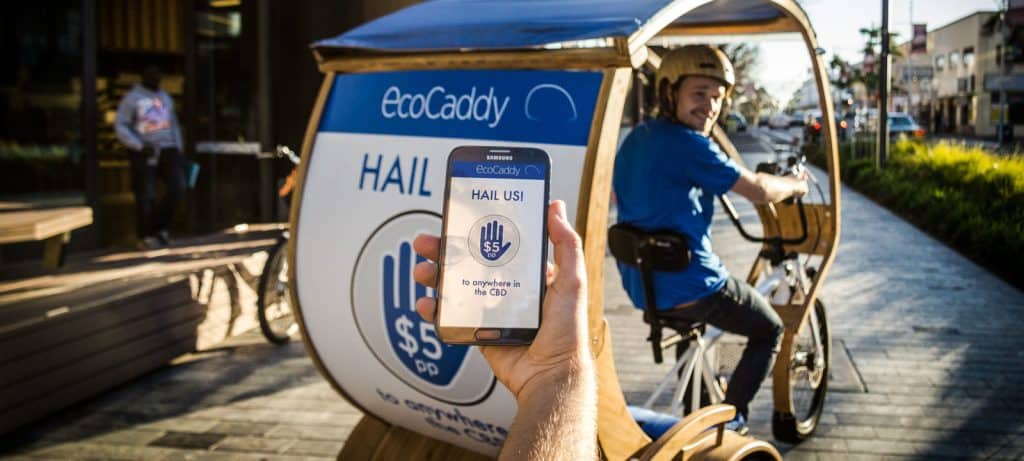
Just about every person who has ever been to Asia has jumped in a tuk-tuk. It’s fun, cheap and brings the streetscape to life. In that part of the world, tuk-tuks are so common they all start to look the same. But put one in Adelaide and the thing will turn heads. When EcoCaddy founder Daniels Langeberg realised this, he knew he had a good idea. In addition to offering cheap cross-city rides, EcoCaddy trikes double as eye-catching moving billboards.
In just one year Daniels has taken EcoCaddy from one rider – himself – to a team of 15, and secured advertising from brands like WOMADelaide, Qantas and the Myer Centre. While that growth is due in large part to Daniels’ personal will (and pedal) power, he didn’t do it alone. He found an investor who believed in his dream as much as he did.
“I was riding one of our bamboo trikes home after a meeting and had to stop to retrieve an item that had fallen onto the road,” Daniels told Inside South Australia.
“When I got back… there were a couple of people standing around patting my dog, who was sitting in the back. We had a great chat… and decided to stay in touch.
“Many coffees later (that person) revealed themselves to be someone with the capacity to invest.”

Daniels Langeberg with his trike.
Daniels says the investor’s decision to back him wasn’t made lightly. “(They) knew I would bust my arse to make this thing happen. I had left my dream job in Shanghai working as an urban designer, moved back (to Adelaide) only to sleep on my sister’s couch for 13 months and… (and I had) put together a solid business plan.”
That plan started with identifying a problem every Adelaidean can relate to. The ‘square mile’ layout of the CBD and pockets of activity in different parts of the city mean trips around town are often too far to walk, but too short to take a cab. Daniels did some market research and proved his hunch, then got started building a fleet of trikes.
“I’d been over in China for the last three years, which is where I met the manufacturers of TreeCycle, which is the trike we use.
“It’s been modified to Australian standards and to suit Adelaide’s roads. We worked with a local engineer and a designer to make them more robust… They are the best trikes in the world in terms of safety.
“Adelaide was the perfect test bed, in terms of climate, terrain and clientele. There are more people moving into the city (and) the ‘islands’ are getting bigger and intensifying… we want to be the connect-the-dots service.”
Rides with EcoCaddy cost $5 per person, with riders paid a wage, rather than working on a commission basis. The genius of the model is that the bulk of the revenue comes from advertising, displayed on the back of the trikes, which EcoCaddy riders pedal around in front of people all day, every day.
“Our point of difference is that we move at a speed and a point in the road that gets a lot of eyes,” said Daniels.

“Building a product that is accepted as comparable to other outdoor mediums, like trams, buses and taxis… that’s taken a bit of work, but we’ve succeeded in that now.
“We are really competitive in terms of our rates for outdoor advertising because the most expensive part of outdoor advertising is the labour to move that advertising around.”
According to Daniels, advertisers are interested in more than just getting eyes on their brand these days; brand continuity and brand association as just as important.
“People want to know who we roll with, who we’ve rolled with in the past, what our company ethos is… all that stuff is now a package.
“Companies like us need to set the standard (and not) just accept advertising as revenue… if it’s s*** advertising with a crap message, don’t put it up, that’s our motto. It was hard in the early days because I had to say no to some good money, but we knew what the long term vision was.”
EcoCaddy plans to pivot and “corner particular parts of the market” in 2016, and will relaunch the brand in late January or early February. Daniels’ advice to other entrepreneurs in Adelaide looking for investment is to canvass widely, and remember that investors aren’t just looking for a great idea – they want to invest in a person that can get the job done. He also has some tips for investors.
“Don’t sit on your money. The bright and passionate people in our state hold the key to ensuring South Australia’s financial sustainability… and who knows, their next great idea might be the thing that can make you abundantly wealthy. If I was an investor not already making moves to find the hottest talent now, I would have some serious fears that I’m already missing out.”