
Highly acclaimed South Australian artist, Robert Hannaford is the focus of this year’s major exhibition at the Art Gallery of South Australia.
Hannaford has spent over 50 years recording life in paint, pencil, charcoal and pen and ink.
He’s also the artist behind the sculpture of Sir Donald Bradman, in the parklands adjacent to the Adelaide Oval, and the
bronze statue of Roy Rene, located on Hindley Street in Adelaide.
But few would know he shares a passion, together with his artist wife Alison Mitchell, for propagating endemic plants and gardening.
Robert and Alison spoke with freelance writer Sophie Armstrong about how their fondness of botany influences them artistically.
Sophie: What is the role of your garden in the creative process?
Robert: It’s like painting. You’ve got to be bold. The garden gives you insights into design, design with nature. That’s what it boils down to. You do it in the garden and you do it in the studio. What you do in your garden does have ramifications to the way you create.
Alison: I think that the garden is a lot about making a structure and that correlates to painting; making a composition right, getting your perspective right and ensuring that those underlying things are right for that painting. Sometimes it’s wrong and you have to pull out everything and start again.
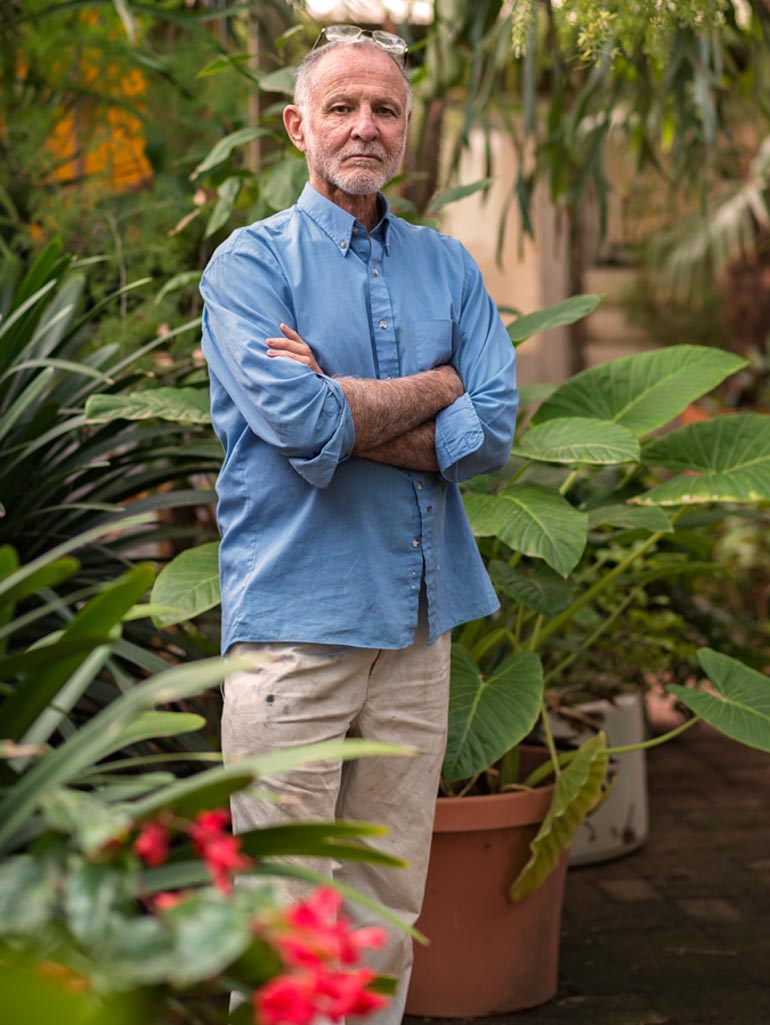
Robert Hannaford in his garden at Riverton
Sophie: Is there a correlation to the way you capture the structure and beauty of faces to the way you do of plants?
Robert: I’m just painting an apple today and its the uniqueness of that apple that I strive for, just as I do if I am painting a portrait. I make no distinction between people and objects when it comes to painting.
Sophie: What is it about endemic plants that is so fascinating?
Robert: Ecologically, because they have evolved in that area, they stand a very good chance of adapting better than most plants to the changing climate. It’s a fascinating question many people are asking about the changing climate: Whether to bring in plants more suited to where we are, a possibly drier scenario.

Bromiliad – oil painting by Robert Hannaford
Sophie: The nature of Endemic plants is that they only flourish in one place. Do you feel that same quality assigns itself to the works created in your Riverton studio?
Robert: There is a bit of a link, when you think about it. (laughs) The natural environment of Riverton, where we now live, is also where I was born and where my forefathers came to. It is my home landscape. I have tried to understand it and the whole world from this particular area. If I understand how it works, then I get a better insight into how everything works in the world. That approach is very much how I paint.
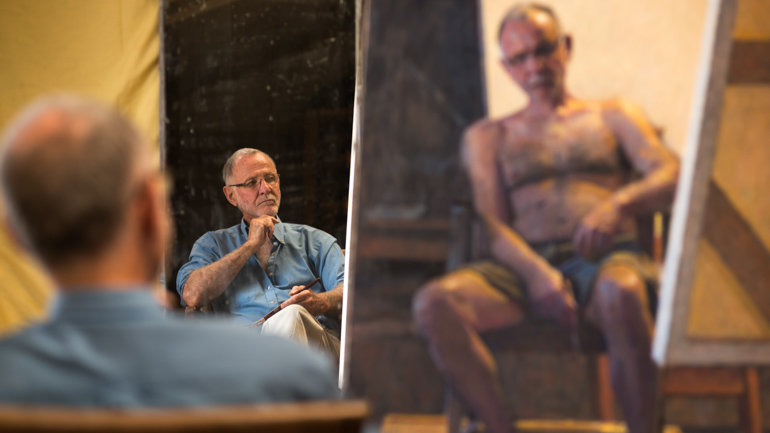
Alison: We paint directly from life so you start to realise that you cannot paint pomegranates unless they are in season. There is a time of abundance and a time of decay. You learn to live with that and you paint what you can when it’s growing.
Sophie: So, you have to be in tune with nature and your creativity?
Robert: Yes, we choose our food based on what it looks like and we often take it into the studio (to paint) before we eat it.

Still life “Winter is a great time to light the studio fire and set up an object in the beautiful overhead light and paint for as many days as it takes.” – Robert Hannaford
The Robert Hannaford exhibition will feature at the Art Gallery of South Australia from July 2 – October 9.
Robert Hanford focuses on 50 years of Hannford’s figuration and portraiture charting the influence of artists such as Rembrandt, Ivor Hele and Hans Heysen on his work.
The Art Gallery’s activity space The Studio will be transformed into The Greenhouse – the botanical theme inspired by Hanford’s passion for botany.
Art Gallery of South Australia is a Brand South Australia member.