By Kerrie Lush
The Arnold brothers are on the quest to produce the perfect piece of citrus fruit.
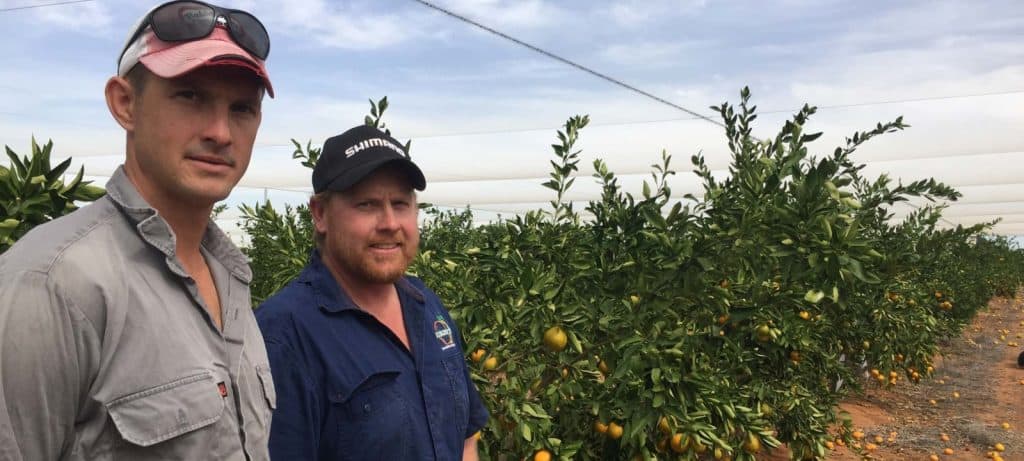
To achieve this, Ryan, Tim and Michael Arnold have covered a proportion of their orchard at Pyap, near Loxton in South Australia’s Riverland, with netting.
The nets help reduce wind rub on the fruit – one of the main causes of skin blemish on citrus.
Higher quality fruit means a larger percentage of the fruit they grow can be sold on the premium Japanese and Chinese markets, resulting in better returns.
“During the drought we had to turn off the irrigation water on the conventional windbreaks (Poplar and Casuarina trees) which were planted around the orchard,” Ryan says.
Post drought, they have been able to create some water efficiencies across their orchard which enabled Pyap Produce to access funding for the net through the South Australian River Murray Sustainability Irrigation Industry Improvement Program (SARMS-3IP).

The Arnold’s have covered 20 hectares of their orchard in a net structure to reduce wind blemish on their fruit
It’s only been a year since they covered 20 hectares (200,000 square metres) of their orchard with the net structures and they’re already seeing the benefits.
Water use has dropped by about 15 per cent, evapotranspiration by up to 30pc and the wind speed through the block is significantly down.
“The trees are growing quite vigorously and the fruit quality, size and yields are also pretty good,” Ryan said.
After being picked from under the net, some of Pyap Produce’s fruit then goes straight on the net – the internet, that is – for sale.
While a local packing shed still takes the majority of their fruit to be sold on both domestic and export markets, their online sales have grown steadily over the past seven years.
“People we’d meet from other areas, particularly Adelaide and interstate would tell us that the fruit they bought from the supermarkets never tasted as good as fruit picked straight from a tree,” Ryan said.

Pyap Produce’s Tim Arnold with some of their mandarins
“We already had a roadside stall but we decided to trial selling online also.
“We’ve really increased our presence on social media in recent years with our Facebook and Instagram pages and we have a blog on the website as we’re finding people are really interested in seeing how the fruit is grown and what happens on the block during the year.
“We take orders all week, pick on Sunday afternoon and the boxes are sent from the post office first thing on a Monday morning.
“The fruit can be in Adelaide as early as Tuesday or to the middle of Queensland by Friday so it’s no more than five days off the trees.”
Customers can choose any mix of navels, mandarins, lemons, grapefruits and cara-cara’s in 5-15 kilogram boxes.
“We take a lot of care in packing the boxes, there’s a lot of attention to detail,” Ryan says.
“I guess it’s artisan in some ways. ”
mapp.data.push( {“alignment”:””,”center”:{“lat”:-34.4487501,”lng”:140.49913419999996},”editable”:null,”filter”:null,”height”:”150″,”hideEmpty”:null,”initialOpenDirections”:null,”initialOpenInfo”:false,”layers”:null,”layout”:”inline”,”mapid”:”20″,”mapTypeId”:”roadmap”,”metaKey”:null,”mapOpts”:null,”name”:”mapp1″,”poiList”:false,”postid”:”5996″,”query”:null,”title”:”Untitled”,”width”:”100%”,”zoom”:10,”pois”:[{“address”:”Pyap SA 5333, Australia”,”body”:”Australia”,”correctedAddress”:”Pyap SA 5333, Australia”,”iconid”:null,”point”:{“lat”:-34.4487501,”lng”:140.49913419999996},”poly”:null,”postid”:null,”kml”:null,”thumbnail”:null,”title”:”Pyap SA 5333″,”type”:null,”url”:null,”viewport”:{“sw”:{“lat”:-34.4823483,”lng”:140.36785099999997},”ne”:{“lat”:-34.37674,”lng”:140.52305660000002}},”html”:”
“}]} );
if (typeof mapp.load != ‘undefined’) { mapp.load(); };
Like this story? Nominate a story from your region.
Click here to nominate >>
These inspiring regional stories made possible by: