
By David Russell
Australia’s greatest film buff will be in South Australia this weekend to share 50 years of movie knowledge at three special Adelaide Film Festival events.
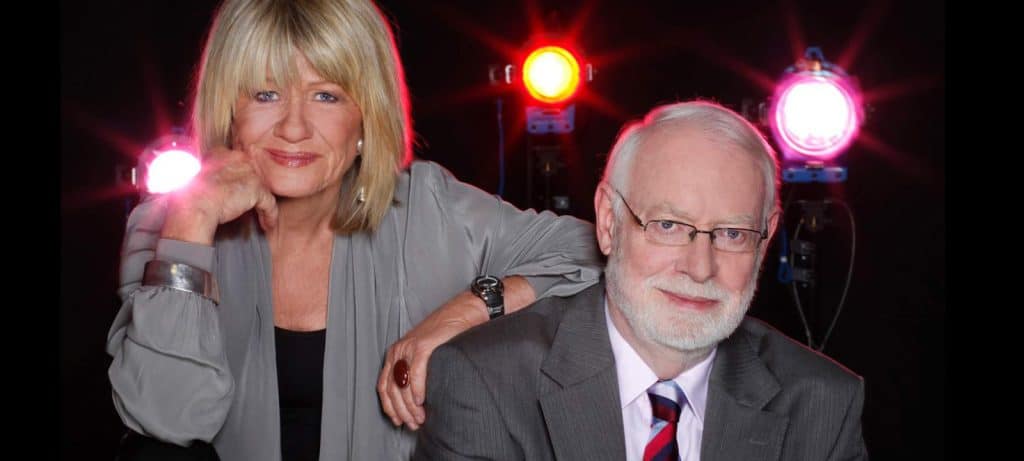
David Stratton will be joined by his The Movie Show and At the Movies collaborator Margaret Pomeranz for the return of the Adelaide Film Festival Quiz Night tonight (Friday 23 October) at the Freemasons Hall on North Terrace. Guests will be able to test their film knowledge against the industry’s biggest brains, with funds raised going to the Film Festival’s Emerging Curator’s initiative.
On Saturday David will be asking three Adelaide Film Festival documentary directors what it means to have your life on show and whether their medium has the power to change the world. The free Selfie Cinema discussion will feature Sam Klemke’s Time Machine director Matthew Bate and subject Sam Klemke, Death of a Chook director Robert Gibson and We Are Many director Amir Amirani, and will look at the growing trend in documentary film of turning one’s camera (or smartphone) on one’s self.
And on Sunday David will be treated to the spring beauty of the Barossa Valley, where he will be hosting Signature Series with David Stratton at Yalumba. It’s an event he’s particularly looking forward to.
“I like a good shiraz from the Barossa,” David told Inside South Australia.
“Just like you have good vintages of wine, so you have good vintage years for other things, and in the film industry too there are years that are better than others.
“So I’ll be talking about some great vintage years as far as I’m concerned in Australian cinema.”
David will be joined by Yalumba’s Robert Hill-Smith, who will treat guests to high tea, complemented by a drop of Yalumba’s latest vintage of The Signature (2012).
Of course, David will be a Film Festival audience member as well. His hit list this year includes Youth, staring Michael Caine and Harvey Keitel, and Carol, starring Cate Blanchett.
A patron and former jury member, David is no stranger to the Adelaide Film Festival.
“There are a lot of festivals around the world that fulfil a role in bringing films to their local communities… having premieres of films from their own country… and the Adelaide Film Festival does that really well.
David sees the Festival’s role as a funder of films, in additional to its curatorial role, as essential to its success.
“The fact is that the festival has a very good track record of helping to fund… Australian films. So it’s been a very successful festival… and I have to say that South Australia has always been the leader in terms of film production. Of all the state bodies the South Australian Film Corporation was the first one to kick off back in 1973.
“I think the future (of the South Australian film industry) is very bright as long as the funding continues. The film industry (in Australia) really goes film to film… if you have a couple of successes that’s great, but then if you have a couple of failures you’re in trouble again, so it’s an industry that you have to really keep nurturing and supporting.”
According to David, funding the production of great Australian film content isn’t just about supporting the industry, its important for the cultural landscape of the country as well.
“Between 1940 and the early 1970s there was virtually no Australian film industry. When the film industry got going again with films like Sunday too far away, which was made in South Australia, Picnic at hanging rock, which was made in South Australia… it was only when that happened and those films started becoming very successful that you realised how important it is to have Australian drama, Australian stories told.
“Otherwise your having a diet of nothing but Hollywood, nothing but an American perspective in terms of entertainment, or perhaps a British perspective, but not an Australian perspective.
“That’s the important thing, and I think every country should have the possibility of hearing its own stories and seeing its own actors and its own creators, working not only in film, but in theatre and television.
“You wouldn’t know what you were missing until you didn’t have it.”